
A non-fundraising Race Night is well suited to company events, weddings, private parties and other celebrations. Guests use tokens or play money rather than real money, watch six recorded races and compete for prizes supplied by the organiser.
No real-money betting takes place. The tokens or play money have no cash value and are used only to keep score. There is no tote income, race sponsorship, horse sale or final-race auction: the purpose is entertainment and friendly competition.
How long does the evening last?
A normal non-fundraising programme has six races, run continuously without an interval. Allow approximately 15 minutes for each race, including taking selections, showing the race, announcing the result and making the token payouts. Running straight through helps maintain the atmosphere and momentum.
How each race works
Before each race, Ron introduces the runners and opens the tote. Guests exchange their token or play-money stake for a numbered tote ticket showing their selected horse. The organiser's helpers record how many selections have been made for each horse. Once everyone has chosen, the tote closes and the recorded race is shown on the large screen.
After the result, the helpers calculate and distribute the winnings. Guests retain their accumulated tokens or play money for the next race. After race six, totals are compared and the organiser presents the agreed prizes.
Individual or team competition?
Decide before the event whether guests will compete individually or in teams. Individual scoring is straightforward for private parties and weddings. Teams can work particularly well at company socials because colleagues can make decisions together and combine their final totals.
Also decide whether there will be one prize, first, second and third prizes, or a prize for the winning team. The organiser supplies all prizes and should have a fair way to resolve a tie.
Tokens or customised play money?
There are two main ways to keep score. Tokens are the simplest and are recommended for most events. Customised play money can add colour and personalisation but requires more preparation and printing.
| Option | Advantages | Points to consider |
|---|---|---|
| Tokens | Easy to count, collect and redistribute. Little preparation is needed. | The organiser must decide how many each guest receives and whether stakes are limited. |
| Play money | Can be personalised with the company, wedding or event details. | The organiser must design and print enough notes. Complicated odds can create very large payouts. |
How many tokens may each guest use?
One simple method is to issue six tokens and allow one selection per race, ensuring that everybody can take part throughout. Alternatively, guests can receive a larger starting allocation and choose how many tokens to risk on each race.
If stakes are unrestricted, some guests may use all their tokens in the early races. Other guests are often willing to share, but the rule should be decided and explained clearly at the beginning.
The recommended token calculation
For each race, the helpers tally the number of tickets issued for each horse and count the total number of tokens staked. After the result, divide the total token pool by the number of winning tickets, working to the nearest whole token.
| Token pool | Winning tickets | Payout per ticket |
|---|---|---|
| 50 | 5 on horse 3 | 10 tokens |
If one guest holds more than one winning ticket, that guest receives the calculated payout for each ticket. The same method is repeated for all six races.
It is possible to invent odds and pay different amounts for different horses, but this makes the tote more complicated. It can also require a large quantity of play money and even pretend cheques when winnings become very high. The simple pool calculation is easier for helpers to understand and keeps the evening moving.
How many tote helpers are needed?
The organiser must provide two reliable helpers for up to 50 guests. Increase the number in proportion to attendance: approximately four helpers for 100 guests, six for 150 guests and so on.
The helpers collect the tokens or play money, issue the correct numbered tote tickets, keep the tally, calculate the payout and distribute the winnings. They must be available for Ron's briefing before the first race and remain at the tote throughout all six races.
Race cards and personalisation
After the booking has been confirmed, Jolly Good Productions can email example blank and pre-named race cards. The organiser can use the standard names or design a customised card.
A customised card can use names connected with the company, wedding party, family, guests or occasion. Race titles, horses, jockeys and other headings can all be adapted. The organiser is responsible for designing the card and printing enough copies to place at least one race card on every table.
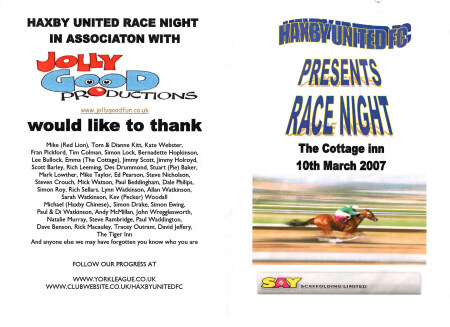
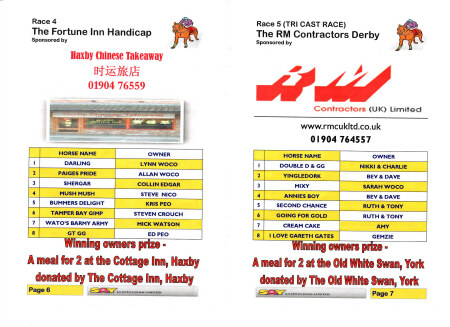
Example of a fully customised race card produced for an earlier event
Planning the room layout
Choose a room large enough for the number of guests and decide where the projection equipment and tote will go before arranging the tables and chairs. Everyone must be able to see the screen and hear the presentation clearly.
The projector and screen should normally be at one end of the room and the tote at the other. A stage can be useful if it is safe and suitable, or the equipment may be positioned in a corner. Keep the projector table and cable route away from normal foot traffic.
Do not place the projection equipment beside the bar, main entrance, fire exit or tote. Guests must not walk close to the projector table or step over cables. Exits, toilets and access routes must remain clear.
What Jolly Good Productions provides
- Ron as Race Night compere and a briefing for the organiser's helpers
- six recorded races selected from flat racing, jump racing, dog racing, trotting races or pig races
- projector, screen and DVD player
- two 100-watt speakers and a microphone
- an iPod for background music while guests make their selections
- an extension cable and numbered tote tickets
- blank or pre-named race-card examples after booking
Electricity parking and access
The organiser must provide a standard electrical socket within approximately four metres of the projector position. The layout must allow the equipment and cables to be installed safely.
Free parking is required close to the venue entrance because the equipment is bulky. If access involves stairs or a long carry, the organiser must provide suitable help bringing the equipment in and taking it out. Tell us about loading restrictions, fixed access times or difficult routes before booking.
Food refreshments and the running order
The six races normally run continuously for about 90 minutes without an interval. If food or refreshments are being served, arrange them before the racing begins or after the final race rather than interrupting the programme.
A typical running order is:
- guests arrive and receive their starting tokens or play money
- Ron briefs the tote helpers
- Ron welcomes the guests and explains the rules
- six races are run continuously, allowing about 15 minutes per race
- final totals are checked and the organiser presents the prizes
What the organiser must decide
- individual or team competition
- tokens or customised play money
- the starting allocation and whether stakes are limited
- a standard or customised race card, with at least one copy per table
- how totals and ties will be handled
- the number and type of prizes
- who will serve as tote helpers
- the safe positions of the projector, screen and tote
Common planning mistakes
- placing the screen where some guests cannot see it
- allowing people to walk around the projector table or across cables
- positioning equipment beside an entrance, fire exit, bar or tote
- failing to decide the token rules before the evening
- using too few tote helpers
- attempting an unnecessarily complicated pretend-odds system
- printing too few race cards for every table to have a copy
- running out of tokens, play money or prizes
- planning a mid-event break that disrupts the momentum
- forgetting close parking or carrying assistance
Information needed for a quotation
- the event date, venue, postcode and type of occasion
- the expected number of guests and requested times
- the room dimensions and proposed equipment position
- access, parking, stairs and carrying distance
- the location of a suitable electrical socket
- whether guests will compete individually or in teams
- whether tokens or play money will be used
- whether a standard or customised race card is planned
- any food, speeches or other activities affecting the timetable
Final advice
Keep the game easy to understand. Tokens, a straightforward pool calculation and a continuous six-race programme are normally the simplest and most reliable arrangement. Decide the rules, helpers, prizes and room layout beforehand, then explain the system clearly to guests at the start.
Bookings and cancellations are subject to the current Terms and Conditions published on the website.